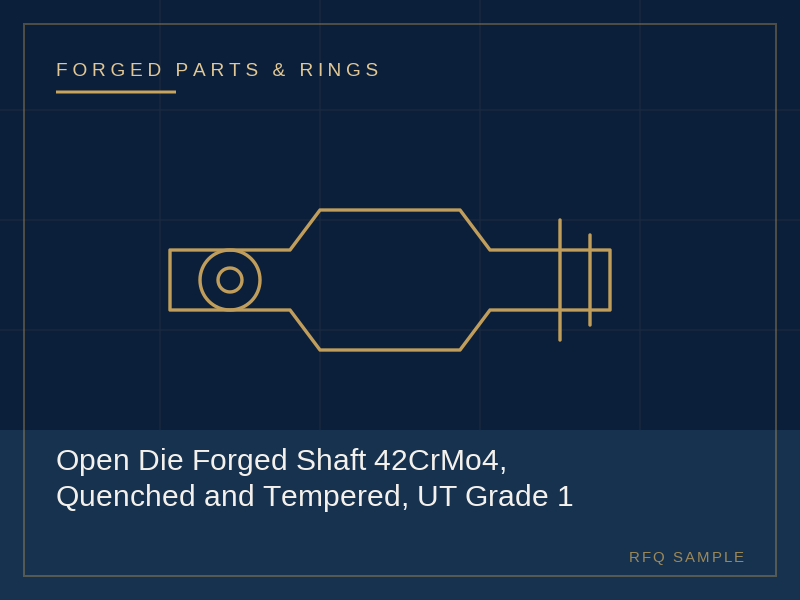
Quenched and tempered alloy steel forged shaft, 180 mm finished diameter by 3,200 mm, UT tested to Class 1, with rough turned surfaces and hardness map.
Reference image — production units follow the approved drawing and the specification table below.
Quenched and tempered alloy steel forged shaft, 180 mm finished diameter by 3,200 mm, UT tested to Class 1, with rough turned surfaces and hardness map. For heavy shafts the question is the core: we report the austenitising soak, the quench method and the hardness traverse so the core properties are documented, not assumed. 42CrMo4 / AISI 4140, 34CrNiMo6 and 25CrMo options and Ø180 × 3,200 mm forged, to Ø900 mm × 12 m capability: those two numbers describe most of what the open die forged shaft 42crmo4 does in service.
Nothing here is left implied: grade 42CrMo4 / AISI 4140, 34CrNiMo6 and 25CrMo options; size Ø180 × 3,200 mm forged, to Ø900 mm × 12 m capability; condition Forged, quenched and tempered to 280 - 320 HB; reduction Minimum 3:1 upset and draw reduction for the section. Built and inspected to EN 10083-3, EN 13443 Class 1 and EN 10204 3.1. 42CrMo4 alloy steel is where we start, and quench and temper heat treatment is the alternative when weight, corrosion or cost argues for it.
Verification documents are compiled against the order: heat number, chemistry, hardness traverse and UT class per EN 10250-3 or SEP1710 on request. Packing follows the same logic — shot-blasted and oiled, on timber skids with dunnage, machined faces protected with VCI — and FOB Tianjin / Qingdao; heavy or oversize forgings by flat-rack or break-bulk. Quotation per piece based on forged weight, die cost amortisation and heat-treatment class.
 New listing