Grinding capacity, not trading capacity
Ø630 × 4,000 mm universal cylindrical grinders and deep-hole broaching are on the same site as the turning line, so tolerance is held in one setup.
Xingtai, Hebei · Hebei industrial clusters · Written first reply within 1 working day; priced answer within 2-5 working days.
Cangzhou precision machining & blade cluster
Our core is the agricultural knife shaft: corn straw return (mulcher) rotors, flail mower and rotary tiller shafts that take daily stone strikes and still hold balance at 540-1,000 rpm. Knife pockets are machined from the solid or built up with welded bosses, seats induction hardened, and every rotor is spin-balanced before it leaves — because an unbalanced mulcher shakes a gearbox to death in one season.
The same shops also run industrial shafts — wood chipper knives, slitter spindles, shredder cuters — where runout, hardness variation and a missed keyway all show up on your assembly line.
We supply complete knife shafts (blade pockets, knives and bolts assembled) or bare machined shafts, depending on how you build your machine.
Verified facts on Knife Shafts
Production capability
These are the envelope numbers our partner shops work to. If your requirement sits outside them, say so in the enquiry and we will name the shop that can do it.
| Shaft length | 300 - 6,000 mm |
|---|---|
| Journals | Ø20 - Ø300 mm |
| Blank | Forged or drawn bar, UT-tested on request |
| Tolerance | Journals IT5-IT6, overall length ±0.1 mm |
| Runout | ≤ 0.02 - 0.05 mm on bearing seats |
| Surface | Ra 0.4 - 0.8 µm ground, Ra 1.6 turning fits |
| Hardness | HRC 28-34 core, HRC 50-58 induction on knife seats |
| Balancing | G6.3 standard, G2.5 for high-RPM spindles |
| Knife pockets | Milled or broached, single / double / four-arm, helix to 30° |
| Keyways & threads | DIN 6885 keys, metric and UNF threads, centre bores |
Definition
A knife shaft is the rotating shaft that carries the cutting knives on a flail mower, straw mulcher or rotary tiller. Whether it survives a season is decided by three call-outs on the drawing: bearing-journal tolerance, knife-seat hardness, and residual unbalance.
Quoted from a 2D PDF or STEP with journal tolerances, hardness call-outs and balancing grade: the quotation prices the shaft line by line, and the dimensional report records the actual journal sizes measured before dispatch.
How an order runs
The reply clock and the factory clock are separate: the first steps run on working days, the last ones run on the schedule named in your quotation.
Specifications last reviewed — the newest product sheet in this category.
Step 1 · Enquiry
Send the drawing, photo, OE reference or a plain description; NDA and confidentiality are available before drawings are exchanged.
Step 2 · Written first reply
Within 1 working day of the enquiry reaching us.
Step 3 · Priced answer
Within 2-5 working days: price per line, lead time, factory route and inspection plan.
Step 4 · Sample or first article
Free DFM (design-for-manufacturing) review on submitted drawings. Samples of stock-standard items ship in 3–7 days, freight collect. Custom parts: first article in 10–20 days after drawing review; tooling cost refunded against the first production order above 500 pcs.
Step 5 · Pre-shipment inspection
AQL 2.5 general inspection on every shipment (AQL 1.0 on safety-critical items). EN 10204 3.1 material certificates, dimensional reports and photos are sent for approval before loading.
Step 6 · Balance and loading
Balance settled in full before the container is loaded, and only after you have approved the inspection report and photo pack; one container, one document pack.
Why this category through us
Ø630 × 4,000 mm universal cylindrical grinders and deep-hole broaching are on the same site as the turning line, so tolerance is held in one setup.
High-speed shafts are balanced on a vertical/horizontal rig and the correction planes are recorded; heavy spot tolerance is written on the drawing.
We supply and match the blades, bolts and wear strips so the shaft arrives ready to install with balanced rotating mass.
Supplier landscape
Three ways to buy this category in China, and the specific failure mode each carries. We name ours plainly.
Where we sit
Knife shafts live or die on balance and hardness records; we hold the shop to both and consolidate the rotor with your wear parts.
Documented specifications
Each sheet is the format we quote in: parameters, materials, MOQ, sampling, packing and the questions that come up before the first order.
 New listing
Knife Shafts
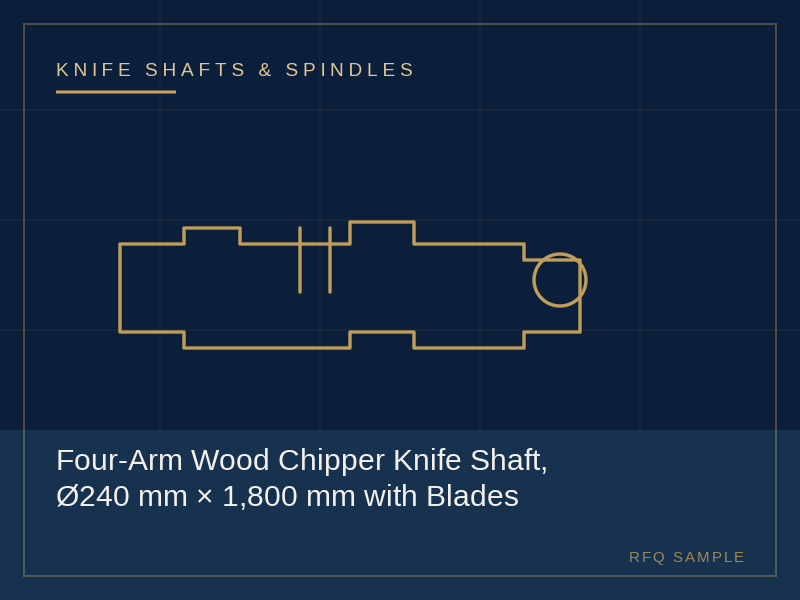
Forged four-arm chipper knife shaft in 42CrMo4, induction-hardened knife seats, dynamically balanced to G6.3, blades and bolts supplied as one matched set.
 New listing
Knife Shafts
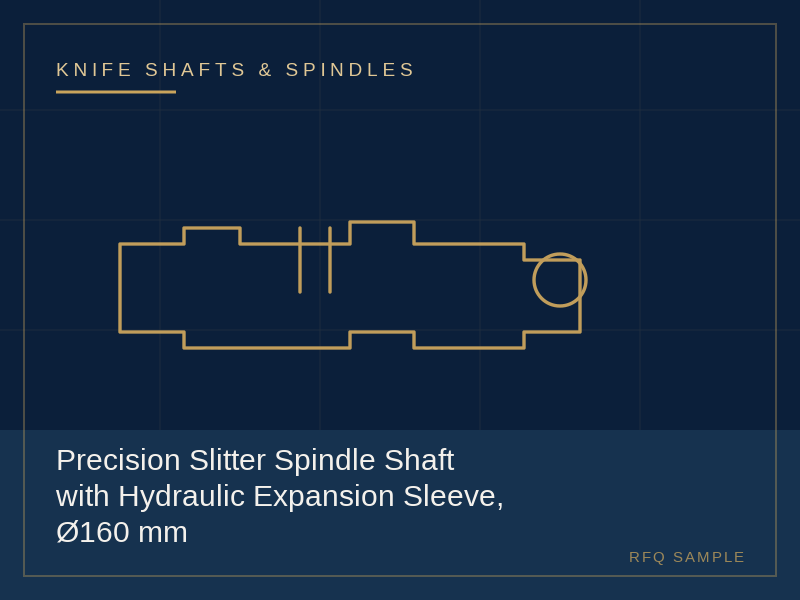
Ground spindle shaft for slitter-rewinder stations: hydraulic expansion sleeve, IT5 journals, G2.5 balance at 6,000 rpm, Ra 0.4 µm sealing surfaces.
Knife Shafts
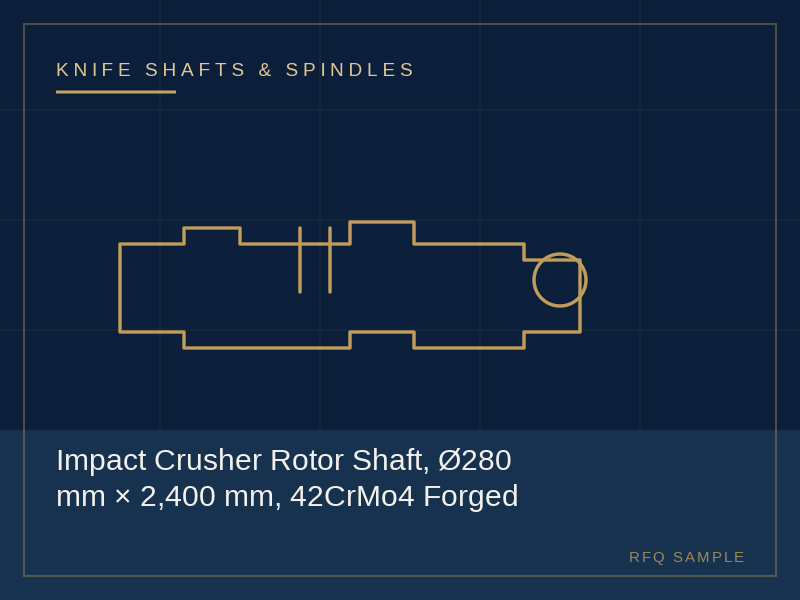
Forged rotor shaft for a hammer impact crusher: Ø280 mm journals, four hammer carrier rows, dynamically balanced and induction-hardened at the bearing seats.
Knife Shafts
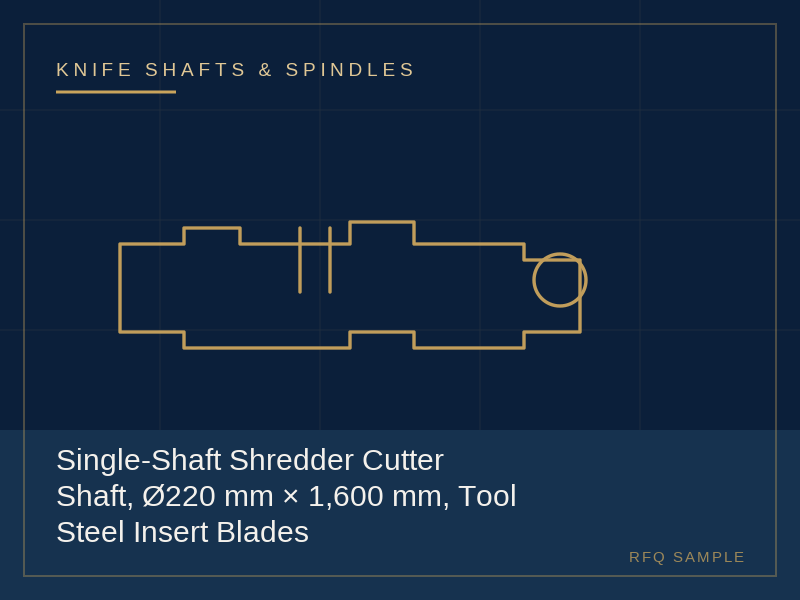
Shredder rotor shaft carrying staggered hook and counter blades: Ø220 mm body, 1,600 mm cutting length, D2 insert blades on a replaceable disc stack.
 New listing
Knife Shafts
Roll and neck assembly for rubber and paper calendars: forged necks machined to the roll body, bush journals, hard chrome and ground sealing faces.
 New listing
Knife Shafts
Stainless agitator and mixer shaft with welded hub, flanged coupling and an intermediate guide bearing, straightened and runout-checked at full length.
 New listing
Knife Shafts
Ground spindle shaft for a belt-driven machining head: ISO 40 taper bore, P4 bearing seats, through-spindle coolant journals, balanced to G2.5.
Knife Shafts
Forming station shaft in through-hardened Ck55 with ground journals, hard chrome and keyed hubs, machined as a set so stations stay in sequence.
Knife Shafts
Shear and guillotine knife shaft with replaceable H1 blade inserts, ground backing face and a hardened clamp rail for chipper and paper trimming duty.
Knife Shafts
Food and pharmaceutical agitator shaft in 316L with electropolished surfaces, welded radiused hubs and a tri-clamp drive coupling.
 New listing
Knife Shafts
Balanced rotor shaft for straw returning mulchers with bolt-on flail seats, heat-treated journals and spline or key drive, built from the original machine drawing.
 New listing
Knife Shafts
Corrosion-resistant blade shaft for rice paddy puddling and stubble burying machines, 40Cr with treated journals, blade seats and a sealed drive end.
 New listing
Knife Shafts
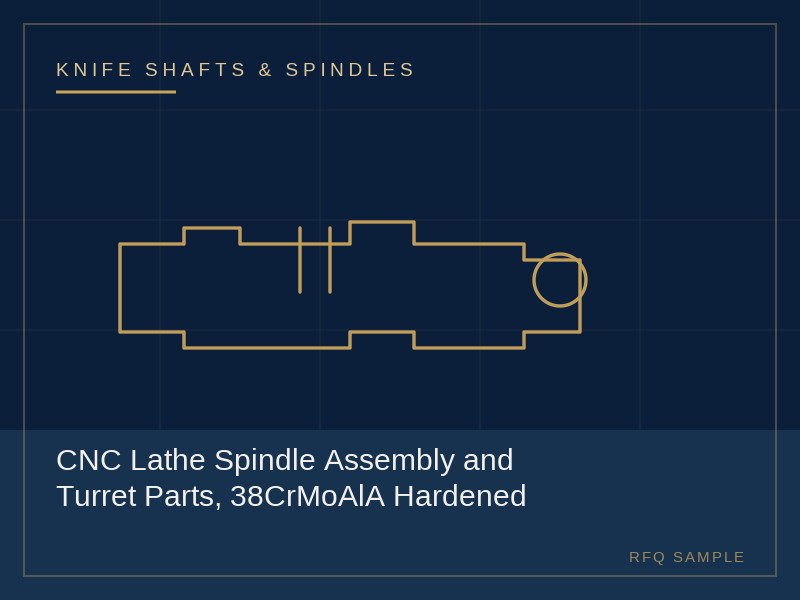
Hardened and ground CNC lathe spindle assembly with nitrided nose, taper test and matching turret parts, machined to the machine-tool builder drawing.
Shop floor notes
Short clips filmed at the supplier shops that build these shafts: the weld, the fixture, the plating, the turning sequence, the calipers and the floor itself. Each clip is 11 to 21 seconds, subtitles are burned in, and nothing is staged for the camera.
The weld is where a knife shaft fails, not the steel. A tacked seam carries the load on a few inches and cracks from there. A full-length weld spreads it across the tube.
The fixture sets the angle, not the eye. Same height, same spacing, every shaft. Two welds can look identical and still sit two degrees apart, and that angle is what the blade hits first. Check the fixture before you check the welder.
Plated teeth, bare tube - not a missing step. The teeth are what cut into soil and moisture, so the zinc goes there. The tube is painted after assembly; zinc under paint just adds cost.
Order matters more than the machines. Turning comes before welding. Weld heat pulls the tube, and a shaft turned after the seam fights that distortion. Machine first, then join - the sequence is the tolerance.
Measured by hand, not by a brochure. A catalogue tolerance is a claim; a caliper reading is a fact. The number that matters is what comes out of the machine, taken at the same point every time.
The floor, no filter. Dust and chips are what the shaft is made in - and what it has to survive. A clean room proves nothing about a part that will spend its life in a field.
Both. Shafts up to about Ø180 mm are usually machined from drawn or hot-rolled bar; larger or impact-loaded shafts are forged with an optional UT report for internal soundness.
J5/k5 or m6 for deep-groove and cylindrical roller bearings, per your drawing. We measure and record actual sizes on the dimensional report before shipping.
Yes — Cr12MoV, H13 or 65Mn blades with heat treatment and grinding, assembled to the shaft with torque-recorded bolts.
Knife seats are induction hardened after rough grinding and before finish grinding; straightness is re-checked on the centre lathe and corrected before final grind.
A 2D PDF or STEP with journal tolerances, hardness call-outs, keyway spec, RPM and the bearing designations. If you have a worn sample, send it — we reverse engineer it.
What we priced
The drawing or sample version, the material grade, and the dimensions we will hold to. One paragraph — long enough that a misread gets caught before the metal is cut.
Price, and what it covers
Unit price, MOQ, trade term, packing and how long the price stands. Where the workshop separates material from machining we show both lines; where it gives one number, we say so rather than inventing a split.
The lead time and what drives it
A date plus the thing behind it: furnace or plating-bath scheduling, the mill minimum for that section, gauge availability. A date with no constraint named is a guess.
What we are unsure of — and what we would change
Written into the quotation, not discovered in the shipment: the fit we cannot confirm, the process we would send outside the belt, the certificate we cannot obtain. Where a cheaper grade or a looser tolerance still does the job we say so; where we have no better idea, we say that too.
What our own paperwork covers, and who issues the rest
The AQL 2.5 inspection report, the material certificate where the category calls for one, and photographs taken before the crate closes.
Not ready to send a drawing yet? Start with the two files we work from — RFQ spec template and the pre-shipment checklist. Fill them in when you are ready; the enquiry box below stays open.
Written first reply within 1 working day; priced answer within 2-5 working days.
Send drawings, a sample description or an existing part number. We reply with price, factory route, schedule and the inspection plan for knife shafts.