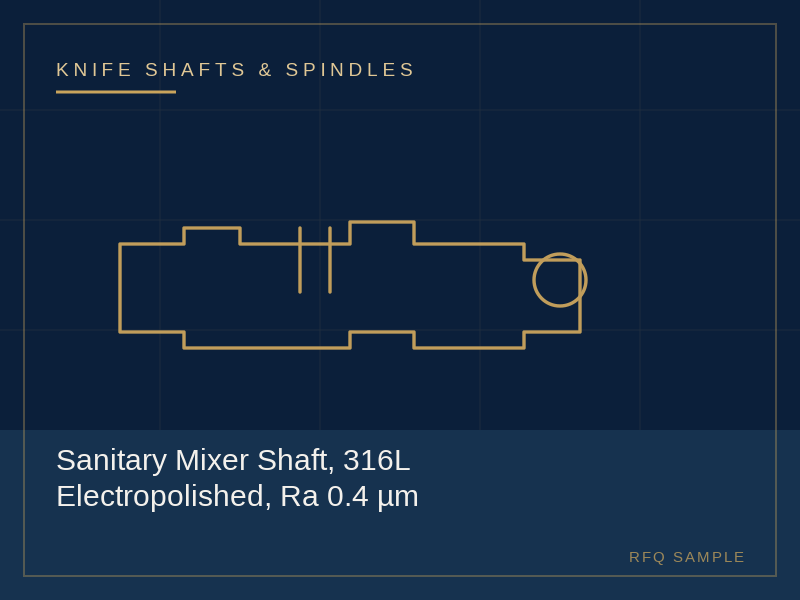
Food and pharmaceutical agitator shaft in 316L with electropolished surfaces, welded radiused hubs and a tri-clamp drive coupling.
Reference image — production units follow the approved drawing and the specification table below.
Hygienic mixing is judged on crevices and welds, so the finish, the radius at every junction and the absence of threads below the liquid line are specified. Food and pharmaceutical agitator shaft in 316L with electropolished surfaces, welded radiused hubs and a tri-clamp drive coupling. In the cangzhou turning and grinding shops this is a running item rather than a special build, which is why material is quoted with a range instead of one catalogue number.
The sheet is deliberately narrow: material 316L / 1.4404 bar, solution annealed; length 1,800 mm (up to 5,000 mm); finish Electropolished Ra 0.4 µm below the liquid line; welds Orbital back-purged, radiused to R3 minimum, no crevices. Built and inspected to EC 1935/2004 contact practice and ISO 2037 fittings. Where the drawing leaves a choice — 316L stainless instead of PTFE scraper option, one tolerance class tighter — we price both, so the decision rests on duty and cost rather than on what the shop happens to have in the rack.
Before the sanitary mixer shaft leaves FOB Tianjin or Qingdao: journals are measured and recorded, hardness and balancing data accompany the shipment with material certificates. Journals are oiled, sleeved and boxed so bearing seats arrive unbruised, so what arrives is what was tested. Quotation driven by shaft length, tolerance class, hardness call-outs and balancing grade.
 New listing