Start from the interface, not the price
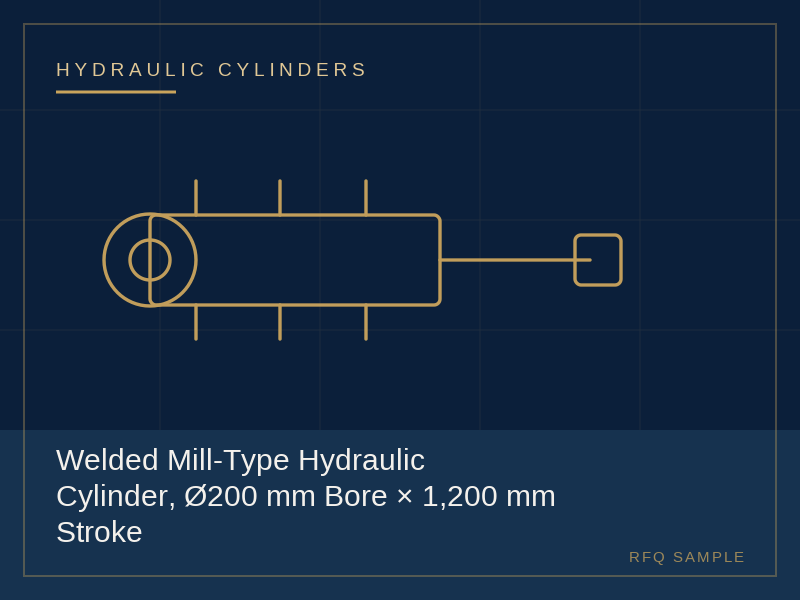
Most cylinder disputes are dimensional. Before comparing quotations, put every offer against the same three items: mounting envelope, port thread and rod-end geometry. Ask each supplier to mark the interface dimensions on your own drawing and return it — a supplier who cannot do that quickly is buying the order, not engineering it.
On welded cylinders, also ask which standard governs the barrel, since that decides weld preparation, honed tube availability and how a repair barrel will be sourced two years later.
Specify the barrel and the rod like a buyer, not a shopper
Write down the tube standard (for example DIN 2396 honed), the bore tolerance (H8 is normal for industrial duty), the surface finish (Ra 0.3-0.4 µm with a plateau finish extends seal life) and the rod treatment with a thickness number, not just "chrome plated". 25-40 µm of hard chrome over induction-hardened Ck45 is a sane default for factory duty; coastal or chemical duty deserves a different answer.
Ask for the measured value from the finished part, not the mill certificate for the raw tube.
Make the seal brand a quotation line
Seals cost a small fraction of the cylinder and cause most of the early failures. Require the seal kit brand and part number in the offer, with a domestic-equivalent option priced separately. If the supplier will not name the brand, assume the cheapest kit they can find that week.
Demand a test sheet with numbers on it
Proof test at 1.5× rated pressure, hold time, ambient and oil temperature, and the result per serial number. A sheet with blanks is worse than none, because it tells you the process is not actually run. Cushion settings should be recorded so your machine does not have to rediscover them.
Calculate side load before you order
Send the mounting arrangement and where the load lands. Guide length and bearing pressure decide whether the rod seals last 6 months or 5 years, and it is far cheaper to lengthen a guide at quotation stage than to argue about a warranty claim later.
Packing is part of the product
Bare cylinders in a container accumulate transit damage on painted faces and rod ends. Require rod and port caps, oil or VCI wrap, and a crate or steel pallet with lashing points. Photograph the packed crate before it leaves the works.
Write the warranty in events, not adjectives
A usable clause says: what is covered, for how long from which date, how a claim is documented, what the remedy is and how fast it comes. Twelve months from bill of lading, replacement parts shipped with the next order or by courier, and a corrective-action note from the shop — that is enforceable across a time zone.
Order a first article and treat it as a tool
Pay for one or two prototype units, strip them, measure them, and put the drawings and the measurement record on file. That file becomes the reference for every future batch, and it is the single most effective way to stop quality drift on reorder after reorder.
Questions this guide raises
What is a normal MOQ for custom hydraulic cylinders from China?
For welded cylinders, 10 pcs per specification is typical, with 1-5 pcs accepted as prototypes. Tie-rod standard sizes can often start at 5-20 pcs because barrel stock is kept in-house.
Should we buy genuine brand or Chinese-brand cylinders?
For replacement into European machinery with a catalogue interface, a factory-brand unit built to the same dimensions and tested with documented numbers is usually the better commercial answer. Where a brand is required, buy it through a traceable channel and ask for batch evidence.
How long does a first-article cylinder take?
Roughly 10-14 days after the drawing is signed for standard sizes, 20-35 days for large bores, long strokes or special coatings.